Swami Vivakananda :

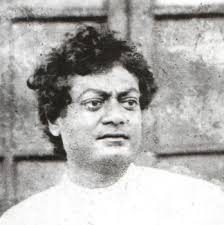
(from wikipedia)
This article is about Hindu monk Swami Vivekananda. For other uses, see Swami Vivekananda (disambiguation).
Swami Vivekananda (Bengali: [ʃami bibekanɒnɖo] 12 January 1863 – 4 July 1902), born Narendra Nath Datta[3] (Bengali: [nɔrend̪ro nat̪ʰ d̪ɔt̪t̪o]), was an Indian Hindu monk and chief disciple of the 19th-century saint Ramakrishna. He was a key figure in the introduction of the Indian philosophies of Vedanta and Yoga to the western world[4] and is credited with raising interfaith awareness, bringing Hinduism to the status of a major world religion in the late 19th century.[5] He was a major force in the revival of Hinduism in India and contributed to the notion of nationalism in colonial India.[6] Vivekananda founded the Ramakrishna Math and the Ramakrishna Mission.[4] He is perhaps best known for his inspiring speech beginning with "Sisters and Brothers of America,"[7] through which he introduced Hinduism at the Parliament of the World's Religions in Chicago in 1893.
Born into an aristocratic Bengali family of Calcutta,[8] Vivekananda showed an inclination towards spirituality. He was influenced by his guru Ramakrishna from whom he learnt that all living beings were an embodiment of the divine self and, hence, service to God could be rendered by service to mankind.[9] After the death of Ramakrishna, Vivekananda toured the Indian subcontinent extensively and acquired a first-hand knowledge of the conditions that prevailed in British India.[10] He later travelled to the United States to represent India as a delegate in the 1893 Parliament of World Religions. He conducted hundreds of public and private lectures and classes, disseminating tenets of Hindu philosophy in the United States, England and Europe. In India, Vivekananda is regarded as a patriotic saint and his birthday is celebrated as the National Youth Day
For more Information Please Visit:
http://www.belurmath.org/swamivivekananda.htm
http://www.rkmathnagpur.org/swami_vivekananda/story_sv.htm
https://en.wikipedia.org/wiki/Swami_Vivekananda
Tony Stark :
Dr. A. P. J. Abdul Kalam :


 Born on 15th October 1931 at Rameswaram in Tamil Nadu, Dr. Avul Pakir Jainulabdeen Abdul Kalam, specialized in Aeronautical Engineering from Madras Institute of Technology. Dr. Kalam made significant contribution as Project Director to develop India's first indigenous Satellite Launch Vehicle (SLV-III) which successfully injected the Rohini satellite in the near earth orbit in July 1980 and made India an exclusive member of Space Club. He was responsible for the evolution of ISRO's launch vehicle programme, particularly the PSLV configuration. After working for two decades in ISRO and mastering launch vehicle technologies, Dr. Kalam took up the responsibility of developing Indigenous Guided Missiles at Defence Research and Development Organisation as the Chief Executive of Integrated Guided Missile Development Programme (IGMDP). He was responsible for the development and operationalisation of AGNI and PRITHVI Missiles and for building indigenous capability in critical technologies through networking of multiple institutions. He was the Scientific Adviser to Defence Minister and Secretary, Department of Defence Research & Development from July 1992 to December 1999. During this period he led to the weaponisation of strategic missile systems and the Pokhran-II nuclear tests in collaboration with Department of Atomic Energy, which made India a nuclear weapon State. He also gave thrust to self-reliance in defence systems by progressing multiple development tasks and mission projects such as Light Combat Aircraft.
As Chairman of Technology Information, Forecasting and Assessment Council (TIFAC) and as an eminent scientist, he led the country with the help of 500 experts to arrive at Technology Vision 2020 giving a road map for transforming India from the present developing status to a developed nation. Dr. Kalam has served as the Principal Scientific Advisor to the Government of India, in the rank of Cabinet Minister, from November 1999 to November 2001 and was responsible for evolving policies, strategies and missions for many development applications. Dr. Kalam was also the Chairman, Ex-officio, of the Scientific Advisory Committee to the Cabinet (SAC-C) and piloted India Millennium Mission 2020.
Dr. Kalam took up academic pursuit as Professor, Technology & Societal Transformation at Anna University, Chennai from November 2001 and was involved in teaching and research tasks. Above all he took up a mission to ignite the young minds for national development by meeting high school students across the country.
In his literary pursuit four of Dr. Kalam's books - "Wings of Fire", "India 2020 - A Vision for the New Millennium", "My journey" and "Ignited Minds - Unleashing the power within India" have become household names in India and among the Indian nationals abroad. These books have been translated in many Indian languages.
Dr. Kalam is one of the most distinguished scientists of India with the unique honour of receiving honorary doctorates from 30 universities and institutions. He has been awarded the coveted civilian awards - Padma Bhushan (1981) and Padma Vibhushan (1990) and the highest civilian award Bharat Ratna (1997). He is a recipient of several other awards and Fellow of many professional institutions.
Dr. Kalam became the 11th President of India on 25th July 2002. His focus is on transforming India into a developed nation by 2020.
For more Information Please Visit:
https://www.facebook.com/presidentkalam
http://www.abdulkalam.com/kalam/
http://www.abdulkalam.nic.in/profile.html
For speech and lectures Please Visit:
http://www.abdulkalam.com/kalam/jsp/display_hints.jsp?menuid=28&menuname=Speeches%20/%20Lectures&starts=0&ends=0
(from wikipedia)
| Swami Vivekananda in Chicago, September 1893. On the left Vivekananda wrote in his own handwriting:"one infinite pure and holy – beyond thought beyond qualities I bow down to thee".[1] | |
| Born | Narendra Nath Datta 12 January 1863 Calcutta, British India |
|---|---|
| Died | 4 July 1902 (aged 39) Belur Math near Calcutta, British India |
| Nationality | Indian |
| Founder of | Belur Math, Ramakrishna Math andRamakrishna Mission |
| Guru | Ramakrishna |
| Philosophy | Vedanta |
| Literary works | Raja Yoga, Karma Yoga, Bhakti Yoga and Jnana Yoga |
| Prominent Disciple(s) | Swami Ashokananda, Swami Virajananda, Swami Paramananda,Alasinga Perumal, Swami Abhayananda,Sister Nivedita, Swami Sadananda |
| Quotation | Come up, O lions, and shake off the delusion that you are sheep; you are souls immortal, spirits free, blest and eternal; ye are not matter, ye are not bodies; matter is your servant, not you the servant of matter.[2] (See more quotations in Wikiquote) |
| Signature |  |
Swami Vivekananda (Bengali: [ʃami bibekanɒnɖo] 12 January 1863 – 4 July 1902), born Narendra Nath Datta[3] (Bengali: [nɔrend̪ro nat̪ʰ d̪ɔt̪t̪o]), was an Indian Hindu monk and chief disciple of the 19th-century saint Ramakrishna. He was a key figure in the introduction of the Indian philosophies of Vedanta and Yoga to the western world[4] and is credited with raising interfaith awareness, bringing Hinduism to the status of a major world religion in the late 19th century.[5] He was a major force in the revival of Hinduism in India and contributed to the notion of nationalism in colonial India.[6] Vivekananda founded the Ramakrishna Math and the Ramakrishna Mission.[4] He is perhaps best known for his inspiring speech beginning with "Sisters and Brothers of America,"[7] through which he introduced Hinduism at the Parliament of the World's Religions in Chicago in 1893.
Born into an aristocratic Bengali family of Calcutta,[8] Vivekananda showed an inclination towards spirituality. He was influenced by his guru Ramakrishna from whom he learnt that all living beings were an embodiment of the divine self and, hence, service to God could be rendered by service to mankind.[9] After the death of Ramakrishna, Vivekananda toured the Indian subcontinent extensively and acquired a first-hand knowledge of the conditions that prevailed in British India.[10] He later travelled to the United States to represent India as a delegate in the 1893 Parliament of World Religions. He conducted hundreds of public and private lectures and classes, disseminating tenets of Hindu philosophy in the United States, England and Europe. In India, Vivekananda is regarded as a patriotic saint and his birthday is celebrated as the National Youth Day
For more Information Please Visit:
http://www.belurmath.org/swamivivekananda.htm
http://www.rkmathnagpur.org/swami_vivekananda/story_sv.htm
https://en.wikipedia.org/wiki/Swami_Vivekananda
Tony Stark :
Dr. A. P. J. Abdul Kalam :


 Born on 15th October 1931 at Rameswaram in Tamil Nadu, Dr. Avul Pakir Jainulabdeen Abdul Kalam, specialized in Aeronautical Engineering from Madras Institute of Technology. Dr. Kalam made significant contribution as Project Director to develop India's first indigenous Satellite Launch Vehicle (SLV-III) which successfully injected the Rohini satellite in the near earth orbit in July 1980 and made India an exclusive member of Space Club. He was responsible for the evolution of ISRO's launch vehicle programme, particularly the PSLV configuration. After working for two decades in ISRO and mastering launch vehicle technologies, Dr. Kalam took up the responsibility of developing Indigenous Guided Missiles at Defence Research and Development Organisation as the Chief Executive of Integrated Guided Missile Development Programme (IGMDP). He was responsible for the development and operationalisation of AGNI and PRITHVI Missiles and for building indigenous capability in critical technologies through networking of multiple institutions. He was the Scientific Adviser to Defence Minister and Secretary, Department of Defence Research & Development from July 1992 to December 1999. During this period he led to the weaponisation of strategic missile systems and the Pokhran-II nuclear tests in collaboration with Department of Atomic Energy, which made India a nuclear weapon State. He also gave thrust to self-reliance in defence systems by progressing multiple development tasks and mission projects such as Light Combat Aircraft.
As Chairman of Technology Information, Forecasting and Assessment Council (TIFAC) and as an eminent scientist, he led the country with the help of 500 experts to arrive at Technology Vision 2020 giving a road map for transforming India from the present developing status to a developed nation. Dr. Kalam has served as the Principal Scientific Advisor to the Government of India, in the rank of Cabinet Minister, from November 1999 to November 2001 and was responsible for evolving policies, strategies and missions for many development applications. Dr. Kalam was also the Chairman, Ex-officio, of the Scientific Advisory Committee to the Cabinet (SAC-C) and piloted India Millennium Mission 2020.
Dr. Kalam took up academic pursuit as Professor, Technology & Societal Transformation at Anna University, Chennai from November 2001 and was involved in teaching and research tasks. Above all he took up a mission to ignite the young minds for national development by meeting high school students across the country.
In his literary pursuit four of Dr. Kalam's books - "Wings of Fire", "India 2020 - A Vision for the New Millennium", "My journey" and "Ignited Minds - Unleashing the power within India" have become household names in India and among the Indian nationals abroad. These books have been translated in many Indian languages.
Dr. Kalam is one of the most distinguished scientists of India with the unique honour of receiving honorary doctorates from 30 universities and institutions. He has been awarded the coveted civilian awards - Padma Bhushan (1981) and Padma Vibhushan (1990) and the highest civilian award Bharat Ratna (1997). He is a recipient of several other awards and Fellow of many professional institutions.
Dr. Kalam became the 11th President of India on 25th July 2002. His focus is on transforming India into a developed nation by 2020.
For more Information Please Visit:
https://www.facebook.com/presidentkalam
http://www.abdulkalam.com/kalam/
http://www.abdulkalam.nic.in/profile.html
For speech and lectures Please Visit:
http://www.abdulkalam.com/kalam/jsp/display_hints.jsp?menuid=28&menuname=Speeches%20/%20Lectures&starts=0&ends=0

No comments:
Post a Comment